The Development of the Greek Alphabet within the Chronology of the ANE
Andrew Cross
University of Calgary
November 29, 2009
The adoption of the alphabet transformed societies by bringing literacy to the masses. Pictogram based writing systems such as Egyptian hieroglyphics required more than 400 signs to represent syllables or objects, many of which had multiple uses. Such a complex writing system required many years of study to gain literacy. With the invention of the alphabet, one only needed to learn 22 signs, each representing a distinct sound or “phoneme.” The democratization of writing which came as a result of the adoption of the alphabet is reflected in the types of inscriptions found before and after. For example, not a single graffito exists in Linear B—a pictograph based writing system—whereas most of the early Archaic Greek inscriptions are graffito—the products of an unexperienced hand.
Despite the importance of the alphabet, there are many questions surrounding its adoption by the Greeks. It is generally agreed that the cultures of the southwestern Levant adopted the Phoenician script around the 11th century BC. However, the Greeks are not thought to have adopted an alphabetic script until much later, around the middle of the 8th century BC. Joseph Naveh disagrees with the late dating noting that archaic Greek inscription share much in common with Old Canaanite and early Phoenician texts that date from the 11th to 10th centuries BC. The standard dates assigned to them should be raised by several centuries.
The earliest use of an alphabet can be traced to Proto-Sinaitic inscriptions discovered in Egypt and the Sinai which date to the Middle Bronze period. The primitive form of the letters proves that the alphabet developed from “acrophony” where “each symbol represents an object whose name begins with the sound to be represented” (Senner 1991). One of the most important Old Canaanite inscriptions—the famous Gezer Calendar—is generally dated to the 16th century BC. Old Canaanite was replaced by linear Phoenician—a transition that is somewhat difficult to nail down but has been dated to around 1050 BC by Frank Cross and Joseph Naveh based on a series of arrowheads found at El-Khadr. These reveal intermediate forms of letters that form a crucial bridge between the Old Canaanite alphabet and the Early Phoenician.
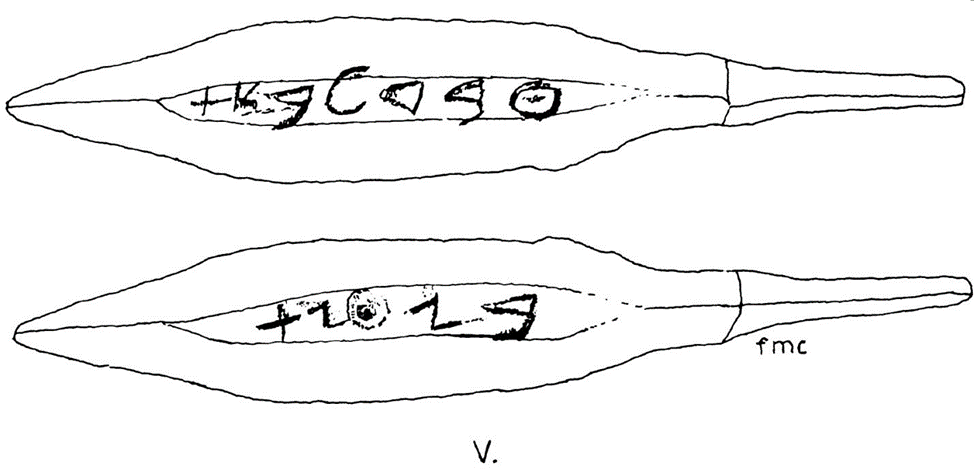
Fig. 1: El Kahdr arrow head No. V depicting Early Phoenician dated by Cross to 1100 BC. Note: omicron has center dot depicting an eye, the archaic ‘nun’ and ‘ayin’, etc. (Cross 1980).
Naveh points to the four lines of evidence which prove that the Greek alphabet developed from the early Phoenician:
- According to Herodotus “the Phoenicians who came with Cadmus… brought into Hellas the alphabet, which had hitherto been unknown, as I think, to the Greeks.”
- The Greek Letters, alpha, beta, gimmel have no meaning in Greek but the meaning of most of their Semitic equivalents is known. For example ‘aleph’ means ‘ox’, ‘bet’ means ‘house’ and ‘gimmel’ means ‘throw stick’.
- Early Greek letters are very similar and sometimes identical to the West Semitic letters.
- The letter sequence between the Semitic and Greek alphabets is identical (Naveh 1982).
It is quite possible that the Greeks learned the alphabet from the Phoenicians through close interaction and intermarriage. This interaction could have taken place in any number of locations. For example, Frank Cross notes the discovery of an early Phoenician inscription found at Tekke on Crete. The “archaic forms of the letters ‘ayin’ and ‘bet’ in the inscription require a date no later than the end of the llth century” (Cross 1980). Based on the inscription found in Crete, it is possible that the alphabet was introduced by Phoenician traders.
Jeffery argues that the Greeks must have adopted the alphabet at a much later date and therefore suggests that the Greek settlement of Al Mina on the Levantine coast near the Orontes River is a more likely location for the transference of knowledge of the alphabet to the Greeks (Jeffery 1961). There were Greek settlers living there by 8th century who would have learned to write Phoenician and then adapt it to their own tongue. The reason Jeffrey places the date for the adoption of the Greek alphabet so late is that no Greek inscriptions have been found dating before the 8th century. Taylor summarizes the archaeological evidence as follows:
There is no evidence of Linear B after the twelfth century and an entirely new form of script, Phoenician-inspired and totally unrelated to Linear B, did not come into use till the eighth century BC” (Taylor 1983).
If Taylor is correct, then this leaves a 400 year gap during which there was essentially no literacy at all. This alone seems unlikely but there are other problems with this hypothesis as well. Epigraphic evidence indicates that the Greeks adopted the semitic Phoenician alphabet at an early stage in its development – long before the 8th century BC.
The Epigraphic Evidence
By the 8th century the Phoenician alphabet had evolved from the Old Canaanite into a systematic and linear alphabet. However, the archaic Greek script was neither systematic nor linear. The earliest inscriptions from the 8th century reveal local variation. The form of the archaic Greek letters are lapidary (ie. ‘cut’ using a square style consistent with engraving) rather than cursive style characteristic of the Phoenician alphabet by the 8th century BC. Joseph Naveh lists a number of letters that share more in common with Old Canaanite than linear Phoenician. He also highlights the variation of symbols for the same letter from Greek inscriptions of the same time period. He notes for example the alpha on the Diplyon vase (8th Century) and on the Arybollos vase (conventionally dated to the 8th and 7th centuries BC respectively).

Figure 2: Early Phoenician inscription found at Tekke, Crete dated by Cross to the 11th century (Cross 1980).
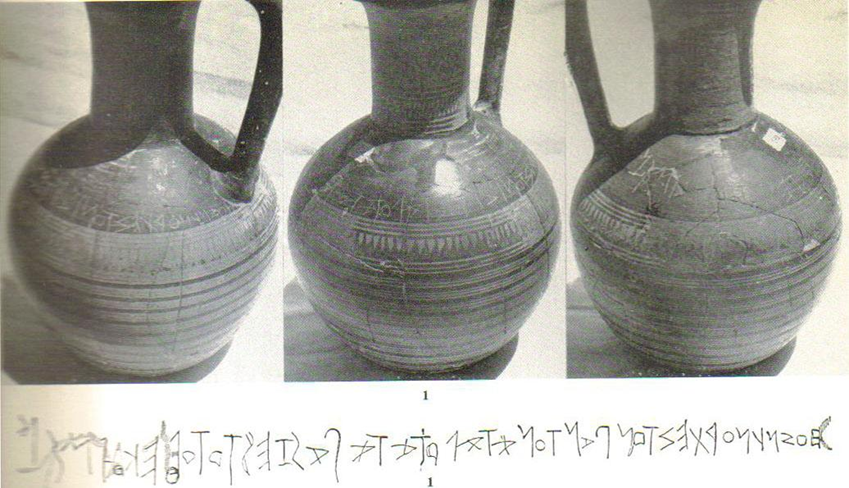
Figure 4: Diplyon vase from the 8th century. Reads from left to right, “Whoever now of all dancers performs most nimbly…” Note the alpha on its side, the crooked 3 bar iota and the hooked pi (Jeffery 1961).
It has been argued that these variations in the Greek script correspond to variations that are found also in linear Phoenician. However, Phoenician, Hebrew and Aramaic were all written with a uniform linear script by the middle of the 8th century BC. Naveh therefore argues that the variations are “realizations of the pictorial conception of the letter forms” that share more in common with Old Canaanite inscriptions (Naveh 1982). In addition to the variation of the letter forms, archaic Greek inscriptions are written right-to-left, left-to-right, and bosphedron. This lack of uniformity was characteristic of Old Canaanite but not Linear Phoenician; its right-to-left orientation was fixed by 1050 B.C. It wasn’t until the 4th century that the archaic Greek forms of script were replaced with the classical Ionian script and the left-to-right direction of writing was fixed. For the Greeks to have adopted the Phoenician alphabet at such a late date would require them to have, in the words of Naveh, “neglected all its achievements and turned it into a more primitive, almost pictographic script” (Naveh 1982).
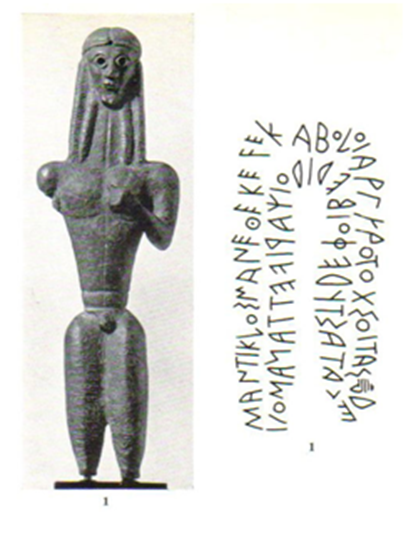
Figure 5: Bronze statuette circa 700-675 BC. Note the bosphedron orientation of writing and the upright alpha.
Another line of evidence that supports an early date for the adoption of the Greek alphabet is the amount of time required to adapt a Semitic alphabet to the needs of Greek speakers. Syllables in Semitic languages always begin with consonants and their vocalic structure is simple. Thus they were able to use alphabets which lacked symbols for vowel sounds (Senner 1991). Greek, on the other hand, had many sounds that did not exist in the Semitic languages and syllables that started with vowels. They therefore had to adapt the aleph to represent ‘a’, the ayin to represent ‘o’, and the het to represent ‘ē’. These adaptations must have taken time. For this reason Joseph Naveh argues that the Greeks must have adopted the Phoenician alphabet perhaps even as early as 1050 B.C. Frank Cross agrees with Naveh, arguing that the, “Greek script was borrowed before the time when the standardization of direction and stance took place” (Senner 1991).
Jeffery disagrees with Naveh and Cross, arguing that the Greeks must have adopted the alphabet in the mid 8th century BC. His reasons are primarily based on the absence of evidence. “Must we believe,” writes Jeffery, “that the inhabitants of Greece in the ninth and first half of the eight centuries, in flat contradiction to the habits of their descendants, forbore to inscribe their pottery with graffiti in any circumstances?” (Jeffery 1961). Although Naveh agrees that the argument from silence cannot be disregarded, he points out that it is known that the Hebrews adopted the alphabet in 12th or 11th centuries yet there is only one inscription—the Gezer calendar—that dates before the 8th century (Naveh 1982). Since then, Ron Tappy has discovered a Hebrew abecedary which he tentatively dates to the 10th century (Tappy 2005). However, Naveh’s point still stands. He suggests that the Greeks may have adopted the alphabet before the 8th century without any archaeological evidence to substantiate this fact if their writing was done on waxed wood tablets, leather or papyrus. Thus Naveh gives more weight to epigraphic evidence whereas Jeffreys gives more weight to the archaeological evidence.
Homer and the Origins of Writing
When considering the origin of the Greek alphabet, it is necessary to consider one of the greatest and earliest masters of Greek literature – Homer. The epic poem of Homer has traditionally been dated to the 8th century BC although Ruijgh places Homer in the 9th century, the same date given to Homer by Herodotus. Ruijgh notes that Homer describes the Black Sea as a gulf of the Mediterranean and he makes no mention of Italy. This is not consistent with an 8th century Greek understanding of geography during which period they made a thorough exploration of the Black and Tyrrhenian Sea. (Ruijgh 2004) Whether we accept an early or late date, the question remains. Is it possible that the alphabet would have just begun to be used by the Greeks at the time when the great Homeric epics were recorded?
Barry Powell argues that Greek literacy must have flourished in an aristocratic world, “really rather like Homer’s description of life in the palace of Alkinoos.” (Powell 1989) Ruijgh envisions Homer performing his poems for Euobian princes – one of the few places in the Greek world where wealth and civilization survived though the Greek Dark Age. Upon comparison of the early Greek inscriptions with those found in other places in the Ancient Near East, it becomes evident that the Greek inscription are almost all written as art and poetry. Noticeably absent is any early Archaic Greek inscriptions that record commercial transactions or even dedications to the gods. Powell therefore argues that, “the Greek alphabet was designed specifically in order to record hexametric poetry.” (Powell 1989) If Naveh’s proposal is correct that the Greek alphabet was introduced in the 11th century, it seems highly unlikely that hexametric poetry would have its genesis in a period marked by cultural decline that would last for centuries. This raises some serious questions about the proposed Dark Age that enveloped Greece for 400 years. How is it possible that a culture developed and refined an alphabet and even wrote hexametric poetry without cultural innovation in other areas such as architecture, pottery or handiwork?
Chronology and the Alphabet
The problems associated with dating the adoption of the Greek alphabet led some scholars to hypothesize that the problem does not lie in the material evidence so much as in the absolute chronology of the Near East. For example, Peter James accepts Naveh’s epigraphic evidence for an early adoption of the Greek alphabet but also agrees with Jeffery that it is unlikely that there would be no archaeological evidence for writing if the Greeks adopted the alphabet in the 11th century. He argues instead for a shortening of the absolute chronology of the Near East by 250 years. James quotes Snodgrass, an authority on Dark Age Greece, “Why did it come about that some four centuries elapsed during which Greek material culture appears to have changed so little? Why did it take so long for literacy, representational art, monumental architecture, and other attributes to appear, or reappear, in the form in which they eventually did?” (James and Thorpe 1993).
| Pottery | Period | Date – Petrie | Date – Torr |
| LHBI – LHBIIIC | Mycenaean Period | 1550 -1100 B.C. | 1250 – 800 B.C. |
| The Dark Age | 1100-800 B.C. | ||
| Proto-geometric | Archaic period | 800-700 B.C. | 800-700 B.C. |
Fig. 6: The traditional and revised dates assigned to chronological periods in Greece.
The original formulation of dates for Mycenae was made by Petrie in the late 1800’s. During his excavations at Gurob, in the Nile Delta, Petrie found pottery identical to that found by Schliemann at Mycenae. The discovery of Mycenean pottery in strata belonging to the 18th and 19th dynasties led Petrie to date the Mycenean pottery to 1580 BC. Cecil Torr thought this date was too high for Mycenean pottery and wished therefore to lower the beginning of the 18th dynasty to 1280 BC. Thus Torr removed the 300 year ‘dark age’ between LHBIIIC and and Proto-geometric pottery types introduced by Petrie’s high chronology. This revision has not received widespread acceptance from scholars.
However, the question of chronology has been revived with the publication of Centuries of Darkness by P. James and I. J. Thorpe. These authors challenged Petrie’s (and later Egyptologists) reliance on Manetho, on the supposed fixed astronomical dates derived from the Egyptian Sothic cycle, and the apparent synchronism between the Biblical Shishak and Pharaoh Shoshenq of the 22nd dynasty. They contend that that the reason no inscriptional evidence for Greek writing has been found before the 8th century is not because the Greeks adopted the alphabet quite late but because the chronology of the Ancient Near East is too high and needs to be reduced by 300 years. Although their revised chronology goes beyond the scope of this paper, it is should be noted that their revised chronology offers a solution to what is otherwise an impasse.
In this paper we have briefly considered the arguments for and against an early adoption of the Greek alphabet and have concluded that an early adoption is most likely. We briefly considered the variation in forms of Greek letters and orientation of writing and seen that this variation is consistent with Old Canaanite. The modification of the script to suit the needs of a non-Semitic language such as Archaic Greek must have occurred over a lengthy period of time – a period longer than what can be reasonably accounted for if the alphabet was adopted in the 8th century. The lack of Greek inscriptional evidence for the alphabet before the 8th century may be due to the rarity of inscriptions as is the case in the Levant or because the length of the Greek Dark Age has been artificially inflated due to its peg to a high Egyptian chronology. We have also briefly considered the dating of Homer’s epics and the requirements of both a settled alphabet and a high level of culture in order to record the epics. It seems most likely then, that the Greeks were introduced to the alphabet through interaction with Phoenician traders who brought the knowledge of the alphabet with them to Euboia as evidenced by the Phoenician Tekke inscription found in Crete.
Bibliography
Cross, Frank Moore. 1980. Newly Found Inscriptions in Old Canaanite and Early Phoenician Scripts. Bulletin of the American Schools of Oriental Research (238):1-20.
James, Peter, and I. J. Thorpe. 1993. Centuries of darkness : a challenge to the conventional chronology of Old World archaeology. New Brunswick, N.J.: Rutgers University Press.
Jeffery, L. H. 1961. The local scripts of archaic Greece; a study of the origin of the Greek alphabet and its development from the eighth to the fifth centuries B.C, Oxford monographs on classical archaeology. Oxford,: Clarendon Press.
Naveh, Joseph. 1982. Early history of the alphabet : an introduction to West Semitic epigraphy and palaeography. Jerusalem Leiden: Magnes Press E.J. Brill.
Powell, Barry B. 1989. Why Was the Greek Alphabet Invented? The Epigraphical Evidence. Classical Antiquity 8 (2):321-350.
Ruijgh, C. October 1, 2004. The source and the structure of Homer’s epic poetry. European Review 12 (4).
Senner, Wayne M., ed. 1991. The Origins of writing. 1st paperback ed. Lincoln: University of Nebraska Press.
Tappy, Ron. 2005. Update: Tel Zeitah Inscription. http://www.zeitah.net/UpdateTelZayit.html.
Taylour, William. 1983. The Mycenaeans. Rev. ed, Ancient peoples and places. New York, N.Y.: Thames and Hudson.