Apollo 8

I am high in the sky, and still I do not see the face of god. Gherman Stepanovich Titov – Russian Cosmonaut

I don’t see any god up here. Yuri Gagarin – Russian Cosmonaut

On December 21, 1968 America launched three of its best men 1/4 of a million miles into space. Their mission was to orbit the moon – for the first time.  Their ride was a Saturn V rocket! I remember seeing one as a kid at Cape Canaveral.  The Saturn V is made of 5.6 million parts screwed, bolted, welded, riveted and soldered together in the shape of a giant Sharpie.  It took 7.5 million pounds of thrust produced by an engine that burned 17,000 tons of fuel a second for this flying skyscraper to escape earths gravitational field and send the space module on its way to the moon. To harness all this power the rocket was equipped with a computer with less processing power than a modern day calculator!

There was a lot that could go wrong on a launch like this. The astronauts privately figured they had a 1 in 3 chance of not surviving and a 2 in 3 chance of not making it to the moon.  At any rate, the insurance companies would not insure them!  (haha, no pun intended) They had good reason not too. The last Saturn V rocket nearly vibrated to pieces on take off and entered orbit in the wrong direction! And of course the tragedy of Apollo 1 was a tragic reminder of the risks involved when that much fire and fuel are together in one place.

Despite the risks, the launch went perfectly.   After three days the capsule entered the moons orbit exactly as planned.  Now, the primary task of the astronauts was to photograph the surface the moon and look for potential landing sites. Public relations were also an important part of mission (after all, they flew to the moon on tax dollars!) and so a broadcast back to earth was scheduled for Christmas Eve. The broadcast would be the most widely listened to broadcast in broadcast history. What were the astronauts supposed to say on this momentous occasion? “Do something appropriate,” was all the instruction they were given from NASA. Astronauts were notoriously poor at describing what they saw.  Some of their briefings were considered a ‘rhetoric disaster’… so it is somewhat surprising that NASA didn’t take a more active role in the broadcast.

The space module lost contact with earth as it disappeared behind the moon. It was a tense period. As one astronaut noted, “once in space hardly an hour would pass without a fresh opportunity for disaster.”  Floating quietly through space on the far side of the moon without a glimpse of the earth was a lonely experience.  For the first time man felt homesick, nor for a street address, but for a planet!  Imagine then, what it was like when Borman caught a glimpse of the earth through one of the small windows in the capsule as they round the backside of the moon!

Borman: Oh my G-d! Look at that picture over there! Here’s the earth coming up. Wow, that is pretty!
Anders: Hey, don’t take that, it’s not scheduled.
Borman: (Laughter). You got a colour film, Jim?
Anders: Hand me that roll of colour quick, will you-
Lovell: Oh man, that’s great!
Anders: Hurry. Quick…
Lovell: Take several of them! Here, give it to me…
Borman: Calm down Lovell.

The photograph taken by Anders became known as ‘earthrise’. Curiously enough, the photograph was not scheduled and seemed to have taken everyone by surprise. The focus of the planners had been on the moon.  That was, after all, what the entire program was about – to get man to the moon. Yet, for those watching the broadcast on Christmas Eve, it was the planet earth that was the focus of attention.  After a general description of their conditions on the module, Frank Borman addressed the citizens of earth,

For all the people on Earth the crew of Apollo 8 has a message we would like to send you,

The three astronauts then took turns reading from the first chapter of the book of Genesis.

In the beginning God created the heaven and the earth. And the earth was without form, and void; and darkness was upon the face of the deep. And the Spirit of God moved upon the face of the waters.

And God said, Let there be light: and there was light. And God saw the light, that it was good: and God divided the light from the darkness. And God called the light Day, and the darkness he called Night. And the evening and the morning were the first day…

Since Copernicus published, On the Revolution of the Spheres, the earth has been demoted from  the center of the universe to just another planet.  The theory of Copernicus was further adopted by scientific materialists to argue that the earth was not placed in a privileged place in the universe by God but happened there by chance (this is the Copernican Principal as opposed to the Theory).  This philosophy allowed the possibility of life elsewhere in our galaxy. In the famous Drake equation, Frank Drake hypothesized that there were likely 10 million communicating civilizations in our galaxy alone. “I feel certain that we can find them now.” wrote Drake. By 1966 Drake’s views where regarded as orthodoxy. Prestigious physicists such as Carl Sagan became vocal advocates of the SETI program that scanned the skies for signs of intelligence. With this in mind, it is somewhat ironic that when man finally arrived in space and was able to look back at earth from 250,000 miles away, an achievement heralded by asto-futurist and scientific humanists as the next great step in human evolution, it actually had the opposite effect. People on earth were not looking out at the stars or at the moon – they were captivated by that lovely shimmering ‘blue jewel’ – bright, full of life, filled with the hopes and dreams of people yet no bigger than a persons thumb when held up against the dark vacuous ocean of space. From this perspective, the earth actually did seem like a very special place. Maybe life is a miracle after all?  For many who listened to William Anders, Jim Lovell and Frank Borman as they read from Genesis, the ancient truths revealed in that text stripped away all pretense to knowledge and power.  Having reached the heights of technological achievement, they chose to reflect on the beauty and the wisdom and the power of God.  This was America’s finest moment.
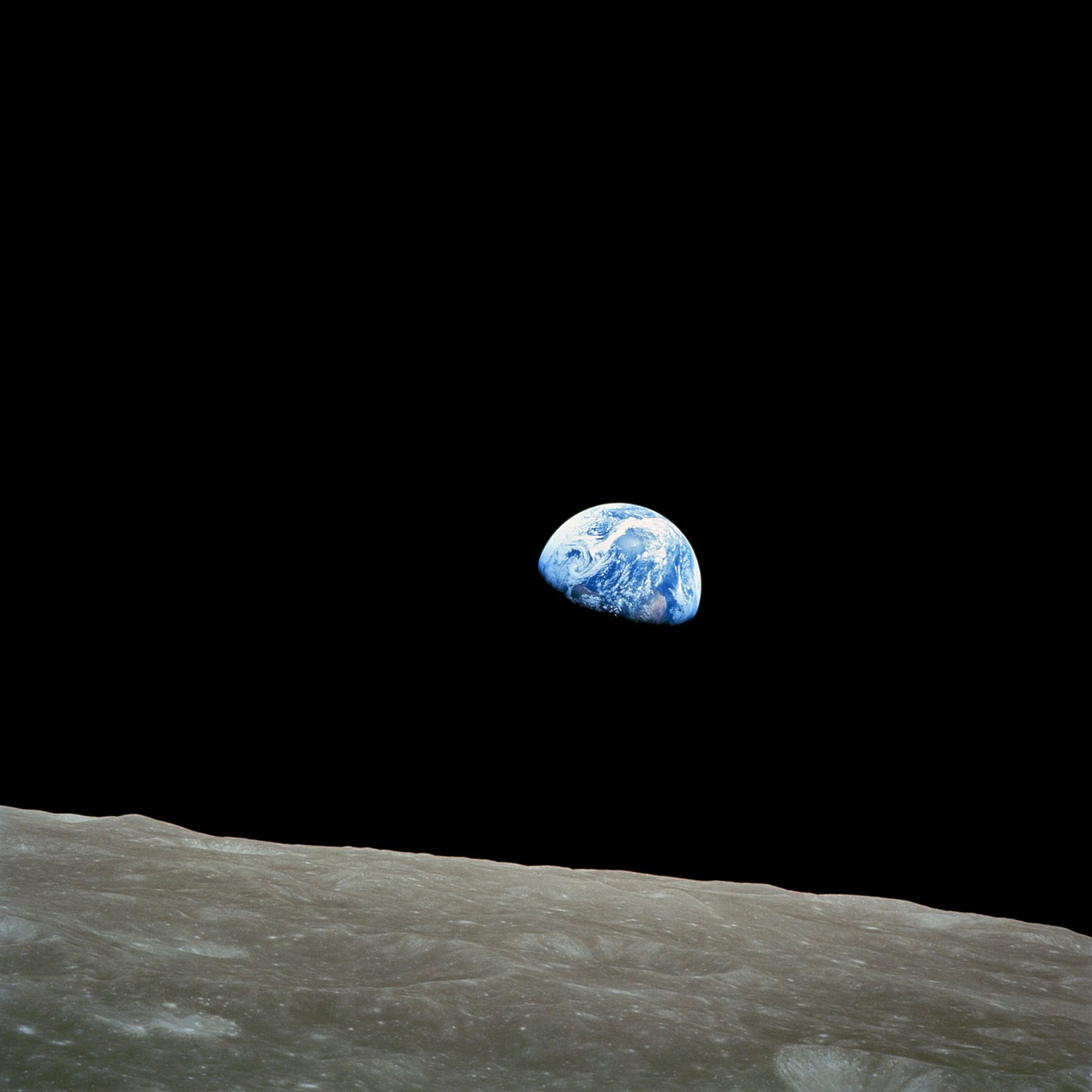
“As is stood in sunshine on this barren world somewhere in the universe looking up at the cobalt earth immersed in infinite blackness, I knew science had met its match. What I saw was almost too beautiful to have happened by accident.” Apollo 17 astronaut Gene Cernan, Earthrise, Robert Poole
The Ancient Paths – The Good Way

Stand at the crossroads and look; ask for the ancient paths, ask where the good way is, and walk in it, and you will find rest for your souls. Jer. 6:16a

Do not be like Israel who said,

“We will not walk in them.”  Jer. 6:16b

The author of Hebrews seems to have Jer. 6:16 in mind when he warns,

“Today, if you hear his voice, do not harden your hearts as you did in the rebellion, during the time of testing in the desert,  where your fathers tested and tried me and for forty years saw what I did.  That is why I was angry with that generation, and I said, ‘Their hearts are always going astray, and they have not known my ways.’  So I declared on oath in my anger, ‘They shall never enter my rest.‘”  Heb. 3:7-11

Graduating

ESV Proverbs 21:1 The king’s heart is a stream of water in the hand of the LORD; he turns it wherever he will.

They are letting me graduate… or I should say one very kind lady in a cubicle on the top floor of a building on a campus has decided… you’ve done enough!

Hurrah!

Common Descent – Part 1

Biola hosted a the debate between John West from the Discovery Institute and Karl Gilberson from Biologos called “Can a Christian be a Darwinist?” You can find it here. In the debate, Gilberson often appealed to ‘the scientific consensus’, that great bastion of orthodoxy outside of which live ROUS, flat-earthers and other miscreants. To belong to this consensus, one must repeat the creed inscribed throughout their sacred texts, “Common descent is a fact of natural history.” Anyone who questions this dogma is, as Gilberson put it, “from the hills of Alabama” – as though this were the ultimate insult.

The theory of common descent is a interpretive framework that makes diversity and complexity a function of mutation and selection. Stephen Gould likened the process to the path a drunk takes from the wall of the bar to the street gutter. Change happens, the outcome is inevitable; the drunk will end up in the gutter and life will lurch from one form to another.

It is a theory that comes from looking at too many wall charts. Every sensible person feels that natures secrets cannot be explained by such a process. Walk through the maple forests along the Niagra Escarpment in October, and the drunk man lying in the gutter choking on his vomit is restored to his proper place as an object of pity. But is there any ‘scientific’ proof that would call into question ‘common descent’? I am not a scientist but I remember a discussion from one of my biology classes that has always stuck with me. It had to do with the molecule lignin.

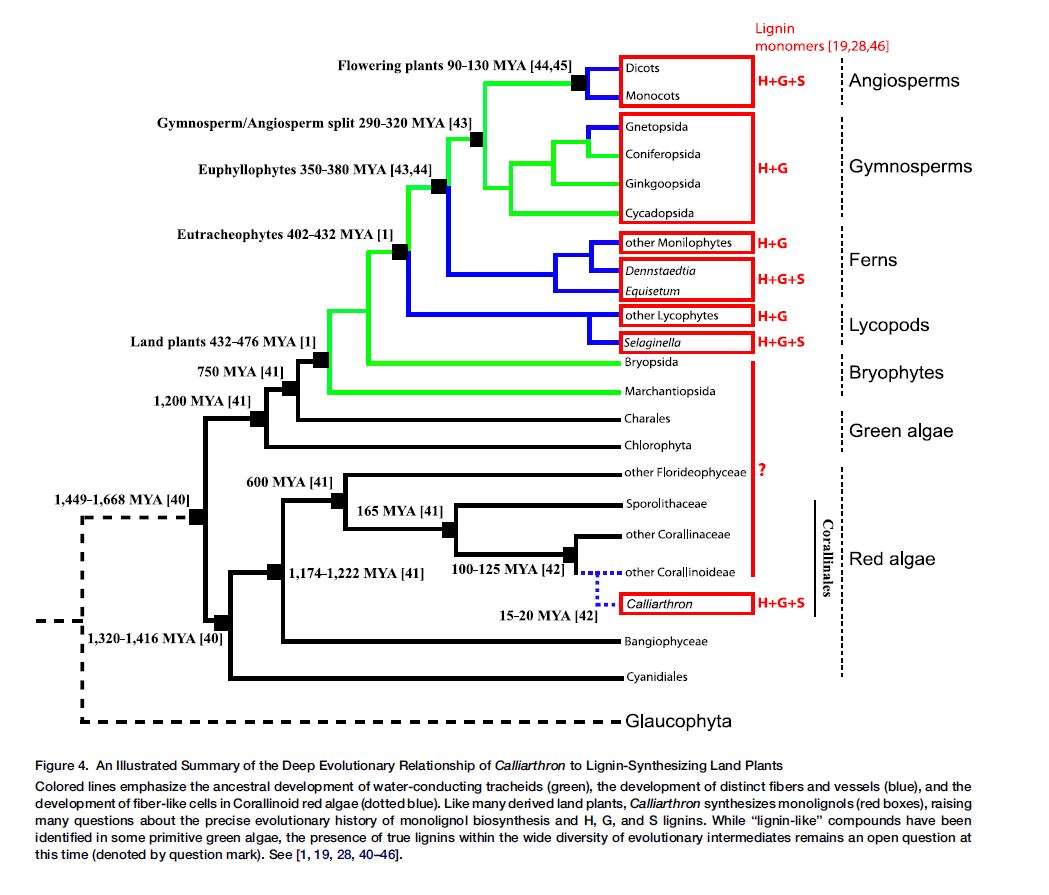
Lignin is what gives strength to the stems of plants without compromising its ability to transport water to its outer branches. A complex molecule synthesized by plants in an equally complex process, lignin has a higher strength to weight ratio than steel. The emergence of lignin is thought to have represented a major leap forward for plant life in the evolutionary scheme. But this has recently been called into question by the discovery of lignin in a species of Red Algae. This find was… well, as one researcher put it, striking!

Monolignols [lignin] have previously been identified exclusively in terrestrial plants and have never been implicated in aquatic algal development; their presence in a marine red alga is, therefore, striking.

Land plants were thought to have evolved from green algae, not red algae, and lignin was thought to have been a later development that only came after the evolution of mosses, liverworts and hornworts. In the tree below, the species with red boxes around them contain lignin. The one at the very bottom is Calliarthron – a species of Red Algae that also contains jignin. It is separated by a vast distance in terms of its relationship to terrestrial plants.


The authors of the paper note the implications of this discovery.

The discovery of polymerized hydroxycinnamyl alcohols [lignin] within the cell walls of red alga has major evolutionary implications. Because monolignol synthesis is exceptionally complex, it seems unlikely that Calliarthron and terrestrial plants evolved monolignol biosynthesis and polymerization completely independently.

It is ‘unlikely’ that lignin evolved separately (or at all for that matter) – about as ‘unlikely’ as someone winning the Indy 500 hammered. Thankfully the authors of the paper do not leave us in the dark regarding this mystery.

We speculate that lignin biosynthetic pathways may have functioned in the common unicellular ancestor of red and green algae, protecting cells from microbial infection or UV radiation and in Calliarthron, lignins may orient the fibrillar scaffolding that guides CaCO3 deposition.

If I understand correctly, they are saying that a unicellular ancestor of red and green algae had the ability to produce lignin even though it had no need of two of the major advantages that lignin is manifestly well designed to provide – strength and water transport. The authors suggest that the unicellular organism used lignin for protection from UV radiation or microbial injection. I suspect this’d be like saying that the new superalloys used in jet turbines were initially developed by Henry Ford for the bumper of his Model T. Even if we were to assume that a unicellular ancestor of algae evolved to produce lignin, it is incredible to think that it was not expressed in land plants for another 1 billion years, nor was it expressed in any other variety of Red Algae that we know of except one, Calliarthron. Now that is conservation!

Ultimately, the whole concept of a tree of life is flawed. It seems to me that the great variety of life is better compared to the spectrum of light. Classifications can be imposed and are useful to a point (ie. red, yellow, green and blue…etc) but to add a time element and infer evolutionary relationships is to say that blue must have evolved from green, green from yellow and yellow from red because that is how they run together in a rainbow.

My information is from here: Discovery of Lignin in Sea Weed Reveals Convergent Evolution of Cell-Wall Architecture

Blessings and Curses

Blessings and Curses in Leviticus:

Israel was Blessed,

I am the Lord your God, who brought you out of the land of Egypt, that you should not be their slaves. And I have broken the bars of your yoke and made you walk erect.

But the Mosaic covenant was conditioned on obedience,

If… you will not listen to me… I will break the pride of your power, and I will make your heavens like iron and your earth like bronze. And your strength shall be spent in vain…

The ultimate consequence was exile. “And you will be scattered to the nations…”

End of story then? No.

If they confess their sins… if then their uncircumcised hearts are humbled and they make amends for their iniquity, then I will remember my covenant with Jacob… Isaac and Abraham… and I will remember the land.

Blessings at Dawn

In Jewish tradition, blessings are said at dawn each morning. The prayer book of Rab Amram Gaon contains 18 blessings – one of which states:

Blessed are thou, O Lord our God, King of the Universe,
who hast given to the cock the mind to distinguish between day and night,
who opens the eyes of the blind.
who clothest the naked.
who settest free them that are bound.

Another blessing, attributed to Rabbi Judah from end of 2nd century, has been widely discussed,

Blessed art thou, O Lord our God, King of the Universe,
who hast not made me a heathen,
…who has not made me a slave,
…who hast not made me a woman.”

Many versions of the blessing exist. For example, a longer version was found in the Cairo Genizah.

“Blessed are you our God, King of the Universe, for having created me a human being and not an animal, man and not woman, Jew and not Gentile, circumcised and not uncircumcised, free and not a slave, pure and not impure”.

The blessing echoes an earlier Greek blessing attributed by Plutarch to Plato as he was dying,

Plutarch, in his Lives, Caius Marius, 46, attributes to the dying Plato an act of thanksgiving to Fortune for having been created a man, and not an animal, Greek and not barbarian. (F. Manns, Jewish Prayer in the Time of Jesus, 118)

Diogenes Laertius attributes a similar saying to Socrates,

Hermippus in his Lives refers to Thales the story which is told by some of Socrates, namely, that he used to say there were three blessings for which he was grateful to Fortune: first that I was born a human being and not one of the brutes; next that I was born a man and not a woman; thirdly, a Greek and not a barbarian.

These prayers are remarkably contrasted by Paul (1st century AD) in Col. 3:11 (cf. Gal. 3:18)

There is no Greek or Jew here,
circumcised or uncircumcised,
foreigner or Scythian,
slave or freeman.
Rather, Christ is everything in all of You.

This statement contained the seeds of ideas which ultimately brought about the emancipation of women and slaves.

(source: F. Manns, Jewish Prayer in the Time of Jesus, 1994 Franciscan Printing Press)

Nations and Nationalism

I have been reading an interesting book by Amos Oz in which he interviews different segments of Israeli about their attitudes towards the land of Israel. One of the main problems he tries to address is how to reconcile his support for Zionism with his negative views on nationalism. The two seem to be mutually contradictory. In one place in the book, he recounts an address he made to a group in Ofra (this was the first ‘settlement’ established in Samaria). He writes,

We can all agree, without difficulty, that what Zionism means is that it is good for the Jewish people to return to the Land of Israel and it is bad for that people to be scattered among the nations. But from that point on – we disagree….

This is the place to make my first shocking confession-others will follow. I think that the nation-state is a tool, an instrument, that is necessary for a return to Zion, but I am not enamored of this instrument. The idea of the nation-state is, in my eyes, “goim naches” – gentiles delight. I would be more than happy to live in a world composed of dozens of civilizations, each developing in accordance with its own internal rhythm, all cross-pollinating one another, without any one emerging as a nation-state: no flag, no emblem, no passport, no anthem. No nothing. Only spiritual civilizations tied somehow to their lands, without the tools of statehood and without the instruments of war.

Amos Oz readily admits that his vision of a world without nation-states is an utopian dream; that in the real world he is, “forced to play the game of nations”, but he feels like a “old man in a kindergarten.”

His words remind me a little of John Lennon’s song,

Imagine there’s no countries
It isn’t hard to do
Nothing to kill or die for
And no religion too
Imagine all the people
Living life in peace

Since the unspeakable horrors of WW2 the West reacted to fascism by pretending that culture is neutral and irrelevant. This is an experiment that is ending badly as European nations will readily admit. The struggle to maintain an open and friendly society and yet maintain ones culture and laws is not new. For example, in Against Apion Josephus tried to defend his people against charge of being a closed society by arguing that the Greeks where no different than the Jews in this regards,

Plato also especially imitated our legislator [Moses] in that he enjoined his citizens to pay to nothing more attention than to this, that every one of them should learn their laws accurately; as also that they should not have foreigners mixing with their own people at random, but that the republic should be pure, and consist only of those who obeyed the laws.

Apollonius Molon failed to consider this, when he accused us of not admitting those who have their own preconceptions about God, and having no fellowship with those who choose to observe a different way of living to ourselves. For this method is not peculiar to us, but common to all men, not to Greeks only, but also to men of the greatest reputation among the Greeks.

From what Ive read of Amos Oz so far, the debate that Josephus was engaged in two centuries ago is alive and well today.

Pascals Memorial

Pascal was a brilliant guy. At just 19 years of age he invented an adding machine to help his dad with his work collecting taxes for Louis XVIII. His little box full of gears and levers became known as the Pascaline, the first functional calculator. In honor of his invention a programming language was named after him in the 1960’s. Pascal’s machine was a small commercial success, 20 of them would be made, but Pascal’s interest shifted to a scientific controversy that raged in his day: “Can a vacuum exist in nature?” His opponents, the Scholastics, reasoned that a vacuum could not exist based on certain assumptions about the nature of the world. But Pascal wasn’t convinced. Why did the Scholastic’s use reason to explain a natural phenomena that should be explained by physical means? With this in mind, Pascal conducted a series of experiments that conclusively proved that a vacuum could exist. (He had his brother-in-law carry a barometer up a mountain to prove the air has mass just like anything else) Today, units of atmospheric pressure are called ‘pascals’ in recognition of his discovery. Pascal is also famous for ‘Pascals triangle’ – as every high school student knows from algebra class. Pascals work on conics contributed to the discovery of calculus and his theories of probability, along with those of others, led to the formation of the first insurance agency. He also developed the first public transit system for Paris.

By his early thirties, Pascal was a star in the salons of Paris. But he had grown disillusioned with the empty and vain lifestyle of the honnet homme, the educated gentleman. Lonely, physically sick and having nearly driven his carriage off of a bridge, Pascal began to think more seriously about spiritual matters. One night while reading John 17, he had an experience that would bring about a profound change in his life. The impression was so vivid that Pascal scribbled some lines on a scrap of paper which he sowed into a shirt pocket. It was later found by accident after his death and would become known as Pascal’s Memorial. It offers a unique glimpse into the soul of Pascal during a difficult period in his life.

The year of grace 1654, Monday, 23 November, Feast of Saint Clement, Pope and Martyr, and of others in the martyrology, From about half past ten in the evening until half past midnight.

Fire

“God of Abraham, God of Isaac, God of Jacob,

not of philosophers and scholars.

Certainty, certainty, heartfelt, joy, peace.

God of Jesus Christ. God of Jesus Christ.

My God and your God.

Thy God shall be my God.

The world forgotten, and everything except God.

He can only be found by the ways taught in the Gospels.

Greatness of the human soul.

‘O righteous Father, the world had not known thee, but I have known thee.’

Joy, joy, joy, tears of joy.

I have cut myself off from him.

They have forsaken me, the fountain of living waters.

‘My God wilt thou forsake me?’

Let me not be cut off from him for ever!

‘And this is life eternal, that they might know thee, the only true God, and Jesus Christ whom thou hast sent.’

Jesus Christ

Jesus Christ

I have cut myself off from him, shunned him, denied him, crucified him.

Let me never be cut off from him!

He can only be kept by the ways taught in the Gospel.

Sweet and total renunciation.

Total submission to Jesus Christ and my director.

Everlasting joy in return for one day’s effort on earth

I will not forget thy word. Amen

(Pascal, Pensees 913)

The Memorial wasn’t meant to be understood by anyone other than himself. But it is clear that over a period of two hours that night, Pascal exchanged human wisdom and philosophy for the God of Abraham, Isaac and Jacob. He had read the likes of Montaigne and the French deists but emphatically turned his back on them. In place of the theoretical God of Descartes, the unmoveable First Mover of Aristotle, Pascal chose Jesus Christ, “the object of all things, the center towards which all things tend.” (Pensees 449)

The Dragon!

We shall not cease from exploration
And the end of all our exploring
Will be to arrive where we started
And know the place for the first time.

TS Eliot

A little boy went out to play in his backyard. It wasn’t long before he became bored with that small, confined area and wandered off across the countryside in search of something more interesting – like a dragon! But the dragons were hiding that day and even giants were hard to find.  With evening fast approaching, he turned back for home, his wooden sword swinging uselessly by his side.

He could see the lights of his house flickering against the grey hills. Behind them, tall mountains with their heads in the clouds retreated toward the horizon. Only then did the boy see the dragon. And no ordinary one at that!  But a big, fire breathing dragon whose fat body covered the entire hillside behind his house!  All he could do was stand there, mesmerized by its pitiless, unblinking eye.  Then like a great hero, he pulled the sword from the loop by his side and prepared for battle. The dragon reared up into the sky, brilliant streaks of yellow and orange, purple and red, lit up the sky, and then the dragon fled away leaving only darkness behind.

The boy hurried home with a slightly longer stride. It had taken a long journey for him to see the dragon in his own back yard!

Parsimony vs. Economy

I have read of some budget proposals in Canada that call for cuts strait across the board. Edmond Burke calls this approach ‘parsimony’. I like this word – parsimony. It sounds like something Id like to have with my apple pie.

Parsimony

1. Unusual or excessive frugality; extreme economy or stinginess.
2. Adoption of the simplest assumption in the formulation of a theory or in the interpretation of data, especially in accordance with the rule of Ockham’s razor.

Parsimony is what every Scotsmans, Dutchman and Conservative is accused of… and what the Obama administration cannot be accused of. But according to Burke, we should seek economy and not parsimony.

Mere parsimony is not economy, it is separable in theory from it and in fact it may or may not be a apart of economy according to circumstances. Expense and great expense may be an essential part in true economy…

Economy is a distributive virtue and consists not in saving but in selection.
Parsimony requires no providence, no sagacity, no comparison, no judgement but mere instinct, and that not of the noblest kind… The other economy has larger views. It demands a discriminating judgement and a firm sagacious mind.

The longer we avoid difficult decisions, the more difficult it will be to avoid parsimony down the road. We could decide that rather than make painful budget cuts, we will inflate our way out of our problems. But this would be truly parsimonious.