Pascal on Natural Revelation

In his Pensees Pascal describes his despair at what can be known about God through nature alone:

This is what I see and what troubles me. I look around in every direction and all I see is darkness. Nature has nothing to offer me that does not give rise to doubt and anxiety. If I saw no sign there of a Divinity I should decide on a negative solution: if I saw signs of a Creator everywhere I should peacefully settle down in the faith. But seeing too much to deny and not enough to affirm, I am in a pitiful state…

We are truly in a pitiful state if all we can know of the meaning of ‘life’ is what we discover through our senses. We look up at the great, majestic trees of the forest and feel that they must be the work of God but then recoil in horror when we watch the grim drama that unfolds on their branches when a parasite takes control of the mind of an ant and causes it, in the last moments of its life, to lock onto a leaf stem with its mandibles and become an incubator for the next generation of deadly fungus.

It would be better that God had not revealed himself to us at all than leave us alone with the light of nature… As Pascal put it,

“I have wished a hundred times over that, if there is a God supporting nature, she should unequivocally proclaim him, and that, if the signs in nature are deceptive, they should be completely erased; that nature should say all or nothing so that I could see what course I ought to follow. Instead of that, in the state in which I am, not knowing what I am nor what I ought to do, I know neither my condition nor my duty. My whole heart strains to know what the true good is in order to pursue it: no price would be too high to pay for eternity.”

So nature makes us thirsty but it doesn’t satisfy our thirst.

Hey from J’lem

I am in the middle of the Summer Ulpan… (still not sure what Ulpan means in Hebrew) at the HU. It is has been great fun and Hebrew is a snap… and every evening Arabs, Jews and Christians and even Atheists join together in song and dance.

It is hard to believe that 3 weeks have gone by already! Today marks the middle of the Ulpan (at least today we wrote the midterm today). I have learned a lot since being here:

1. A 110 V clothes iron gets hot quickly when plugged into a 220 V outlet. You can iron a hemp shirt left damp in the dryer for 2 days in a flat 60 seconds. The secret is to always keep the iron moving and to make good use of the steam function. Its a good idea to keep a window open nearby to toss the flaming shirt if you run out of water or absent mindedly (my spell check says that isn’t word?) leave the iron rest in one spot for more than a few seconds.

2. Don’t be offended if the man behind the falafel stand looks at you like your an imbecile. If someone ordered a hamburger in your country by pointing to different pictures on the menu and saying, “There is a meat, there is a bread, there is a salad and there is a pickle” and then asks “How much to pay for the dog?” well, you’d probably look at them the same way.

3. Pedestrian walks are optional. You have better odds playing Russian roulette with a derringer than you do with Israeli crosswalks. It is best to understand that the white lines painted on the road are a memorial to former pedestrians who thought they had the right of way.

So it has been a good 3 weeks and I am grateful to be here.

I will write more later and post some pics soon.

PS – If you came across this blog by Googling “mindedly” please leave a comment. I would love to hear from you.

Nerzhin vs. Sologdin

In “The First Circle”, Solzhenitsyn contrasts the world view of an agnostic and a Christian through the lives of two men, Nerzhin and Sologdin. Both are prisoners in the Gulag trying to make sense of their lives.

Disenchanted with Communism, Nerzhin has retreated into skepticism. Although he is a scientist working on a top secret project for Stalin, he wants to quit his mind-wearying work and return to hard labour so that he can focus his mental energy on finishing a book that he had started writing in secret.

Sologdin, on the other hand, is a Christian.  Solzhenitsyn describes him in the following way:

“He was a non entity, a slave without rights. He had been inside for twelve years, but because he had been sentenced to a second term, there was no knowing when, if ever, his imprisonment would end. His wife had wasted her youth waiting in vain for him. To avoid dismissal from her present job, as from so many others, she had pretended that she had no husband and had stopped writing to him. Sologdin had never seen his only son – his wife had been pregnant when he was arrested. Sologdin had gone through the forests of Cherdynsk, the mines of Vorkuta, two periods under investigation, one of six months, one of a year, tormented by lack of sleep, drained of his strength, wasting away. His name and his future had long ago been trampled into the mud. All he possessed was a pair of well-worn padded trousers and a tarpaulin work jacket, kept at present in the storeroom in expectation of worse times to come. He was paid thirty rubles a month-enough for three kilos of sugar-but not in cash. He could breathe fresh air only at stated times authorized by the prison authorities. And in his soul there was a peace that nothing could destroy. His eyes sparkled like those of a young man. His chest, bared to the frost, heaved as though he were experiencing life to the full.”

The two men volunteered to cut wood for the camp because they believed that it was good for the soul. In between their sessions pulling on the handles of a whipsaw, they spoke about God and the meaning of life.

Nerzhin sighed.

“You know, I don’t even mind acknowledging a Creator, some sort of higher Reason in the universe. I’ll even say that I feel it to be so, if you want me to. But supposing I found out that there is no God, would I be any less moral?”

“Undoubtedly!”

“I don’t think so. And why do you have to insist, why do all of you always insist, that we must recognize not just God in some general sense but a concrete Christian God, plus the Trinity, plus the Immaculate Conception? Would my philosophical deism be the least bit shaken if I learn that not one of the Gospel miracles ever happened? Of course it wouldn’t !”

Sologdin sternly raised a hand with an admonitory finger.

There’s no other way! If you begin to doubt a single dogma of the faith, a single word of the Scriptures, all is lost! You are one of the godless!”

His hand slashed the air as though it held a saber.

“That’s what repels people! All or nothing! No compromises, no allowances made. But suppose I can’t accept it in toto? What can I be sure of? What can I rely on? I keep telling-the one thing I know is that I know nothing.”

Socrate’s apprentice took hold of the saw and offered the other handle to Sologdin.

“Another time then,” Sologdin agreed. “Lets cut wood.”

A. Solzhenitsyn – The First Circle

——-

Solzhenitsyn was exactly right that the dogmatism of Christians is what repels many.  Christianity is an “all in” proposition. Faith does not deal in probabilities.  From this perspective, faith might be viewed as restrictive but what is the alternative?   Apart from Scriptures, what do we know? Do we know that God is One? Do we know that God is Love? Do we know that sin is a corruption of what is good? Do we know that we are created in the image of God?  Do we know that life is sacred? Do we know that there will be a resurrection and a final judgment? What do we know of the Atoning Sacrifice? Do we even have a word for holiness? Do we know of the sanctity of marriage? Do we know about Christ and the future Restoration of all things? Do we have hope? Does anything remain of what we love and cherish?   No.  All we are left with is the gods of the Greeks and Hindus.

Christians are not far removed from skepticism.  We never bought into the promise of scientific positivism embraced by Enlightenment thinkers before the time of Europe’s Troubles.  We can pretty much agree with Nerzhin when he said, “The one thing I know is that I know nothing.”   We know nothing… apart from faith.  It is faith that makes the difference.

Joe

Joe.

He was a former roommate… about 26 yrs old.

On the day he moved in, he was beaming from ear to ear. He told me later that he had been on the streets but was trying to make a change in life. He was done with drugs, he said. Joe was scrupulously clean and I could tell that he was thrilled to be living in a decent place. I am not sure who it was that helped him move in. He sometimes spoke of his mother but according to Joe, she was living with a man that didn’t like him very much. Joe didn’t have a job although he pretended that he worked for a broker selling insurance. That was all a lie. As he later admitted, he was living off of gov’n checques. He spent most of his days laying World War Craft.

On the night I moved out he told me he was in trouble. “My mind is like a Picasso, you know those paintings where nothing makes sense.” Joe had a problem with paranoia. He once told me he thought someone was poisoning the water because it had a funny taste. I told Joe that these thing were not real and that he shouldn’t mention this to anyone. But he didn’t listen. I heard later that he had been kicked out of his place because he accused his roommate of breaking into his room and had screwed a padlock to his door.

He is living in dark, rank basement now and paying about the same rate as he did for the last place. He told me that people somehow know things about him and that there is a conspiracy to keep him from getting a place to live. He doesn’t understand that people judge by outward appearances; by the way a person carries themselves and how they speak. Joe never learned those social graces.

The hallway down to Joe’s basement suite.

The Kitchen / Laundry room


Joe’s Bedroom


Joe said he was something of an artist which, I admit, I doubted. But he gave me this picture the next week – all done with a ball point pen.

I wonder sometimes if there is hope for Joe? Was there hope for the people of Naphtali and Zebulun?

A land wrapped in darkness like a cold wet blanket. A place of gloom where every song is screamo, every procession a funeral and every glance an accusation.

Those walking in darkness have seen a great light. Isaiah 9:1,2

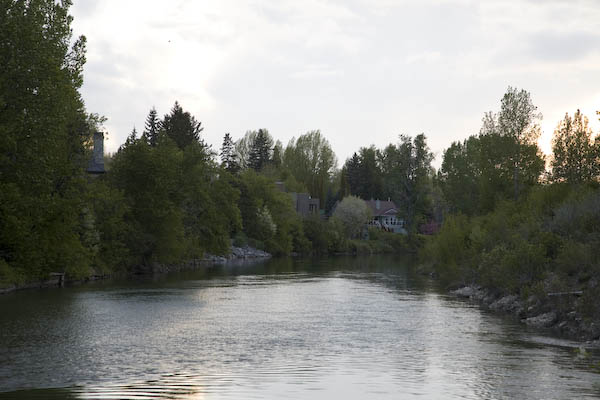
Elbow River

Took a few pics this evening down along the Elbow… It is real nice this time of the year. The river run through the middle of the city but I have seen beaver, muskrat, a coyote with her pups and, last night, an osprey. What I haven’t seen is any fish rise to the surface… still tempted to try my luck…


Our house for the last 6 months. It has been a great place to stay… i just noticed from this pic that our Christmas lights are still on… I’d better go shut those off.

Virtual Reality

Thought this was interesting:

So to put it in round numbers, over the next two decades, there is likely to be about a one-hundred fold increase in the amount of available computation capacity. Therefore, anything that can be done with computation will get significantly better, cheaper, and lighter. Robots and machines will become faster and more skillful. Mobile phones/computers will be lighter and have better screens. Cameras will be smaller and much more pervasive and the software for processing their images will be much more powerful. Games and movies will have much better and more realistic animation. Video-conferencing will be much higher quality.

In short, as the physical environment continues to slowly degrade, the virtual environment is likely to get much better. I imagine that will lead people to spend more and more time in the virtual environment.Source

Technology saves time and has raised the standard of living. We can be thankful for this but that last paragraph scares me a little. I don’t know about you but I don’t want to become a part of that trend. Although more subtle and less destructive than drugs, it is also more pervasive and difficult to resist.

Miracles and Evidence

Paraphrased from Sir Robert Anderson “The Silence of God”:

Like Nicodemus, we cannot reason our way into the Kingdom of God. We must be born again.

Peter, an apostle of Christ, and acquainted with the miraculous, wrote “we are born again, not of perishable seed, but of imperishable, through the living and enduring word of God.” It is through the divine Word that we come to know God.

Revelation validates miracles and not vice versa. The apostle Paul wrote, even if an angel from heaven should speak a different Gospel, let him be cursed!

The evidence of miracles is subordinate to the testimony of Scripture.

The evidential value of revelation; an analogy:

An undercover agent is sent on a mission into a foreign country on a mission. His instructions are that he is to enter the country and await an envoy who will provide him with the details of his mission. How is he to know whether the envoy is credentialed? The agent is given a piece of paper that has been torn in half. The envoy will carry the other half.

Jesus is the anti-type to every type in the OT.

“The question, then, is not whether a revelation can be accredited by external evidence, but whether such evidence can avail to accredit a person whose coming has been foretold. And this no accurate thinker would for a moment dispute” A.T.R.

The World is Thus

You had no alternative your Eminence
We must work in the world… the world is thus
No senior Hanto… thus we have made the world… thus have I made it.

The Mission